
The Evolution of the V. Richelieu Workshop
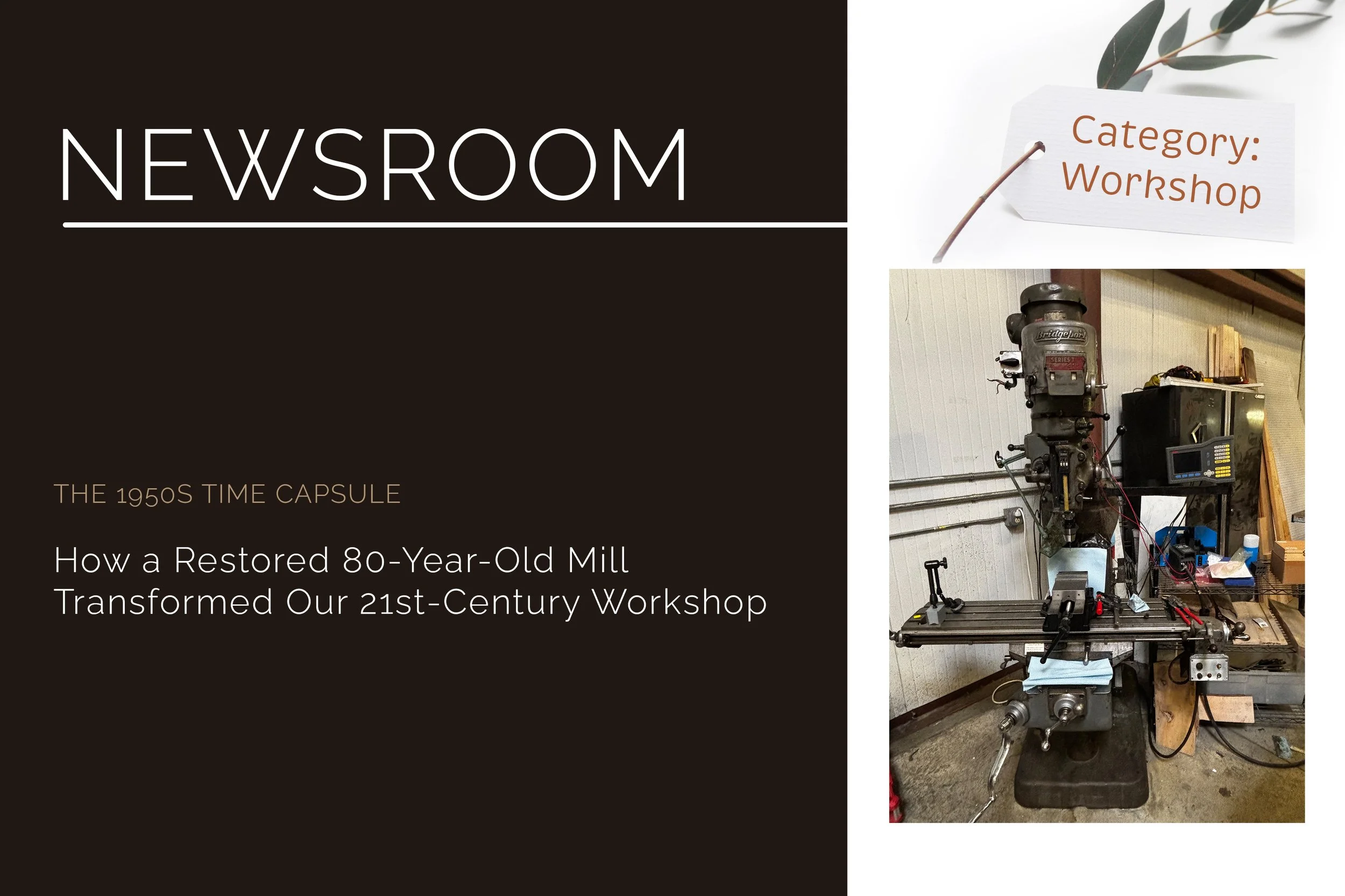
How a Restored 80-Year-Old Mill Transformed Our 21st-Century Workshop
BURLINGTON, VT — May 29, 2026
Inside the V. Richelieu workshop, the faint whine of a computer-guided, 6-axis Italian CNC carving bit stands side-by-side with a silent heavyweight from another era: a newly restored, 100% solid-steel milling machine from the 1950s.
To the casual observer, they look like a contradiction. To our luthiers, they represent the absolute core philosophy of V. Richelieu and Vermont Violins: one foot deeply rooted in the past, and one foot stepping boldly into the future.
The story of this workshop evolution shows that advanced automation and ancient heritage don't just coexist—they make better instruments.
The Evolution of the V. Richelieu Workshop
When we began crafting our own custom violins and fractional violas nearly 20 years ago, our workflow was completely manual. The heavy power tools of our early days consisted of a simple sander and a single drill press.
Every single component—from plate carving and rib bending to intricate purfling inlays—was driven purely by human muscle.
While beautifully romantic, the early stage of violin making requires roughing out thick blocks of tonewood (spruce and maple) into thin plates. Historically, this meant hours of intense, physically exhausting hand-gouging. It was incredibly punishing on the hands, wrists, and bodies of our luthiers, leaving them aching by the end of the workweek.
To protect our craftspeople and elevate our efficiency, we began integrating mechanical partners:
2014 (The 3-Axis Era): We acquired our first Axiom three-axis CNC machine. Driven by computer programming, it took over the brutal work of hogging off heavy waste wood. While highly accurate, it was slow, un-angled, and chewed through cutting bits.
2021 (The 6-Axis Breakthrough): We escalated our workshop capacity with a massive, state-of-the-art 6-axis CNC milling machine engineered in Italy. This powerhouse features automated tool changing and handles complex geometries—including the incredibly sophisticated curves of a violin scroll—down to a tenth of a millimeter of accuracy.
The Fine Line Between Machine and Handwork
A common question we face from players and traditionalists is: If a computer can carve a violin to 0.1mm accuracy, why do you still need a luthier?
The answer lies in the living nature of wood. A computer program cannot feel density, note a strange grain direction, or listen to the tap-tone of a piece of split Swiss spruce or Bosnian maple.
Our Golden Rule: We deliberately leave extra wood on our machine-milled plates. The machine gives us a safe, precise head start. The master luthier then takes over using a tiny thumb plane for the final, meticulous graduations. This allows our artisans to make intuitive, split-second judgments based on the unique flexibility and weight of that exact piece of timber.
The 1950s Tool Restored for a 2026 Fleet
Our newest workshop asset isn't new at all. We recently saved an elegant, 80-year-old manual milling machine from obsolescence. Built in an era before plastic shielding, the machine is constructed entirely of cast iron and solid steel. It was engineered to run forever with just a bit of care.
| The Workshop Time Capsule Comparison | |
|---|---|
| Feature | 1950s Manual Mill vs. Modern 6-Axis CNC |
| Material Build | 100% Solid Steel & Iron vs. High-Tech Composite & Plastic Shields |
| Driver Mechanism | Human Hand & Eye Guidance vs. CAD/CAM Digital Programming |
| Set-Up Complexity | Ultra-Simple, Mechanical Clamping vs. Intricate 3D Spatial Fixtures |
When it arrived at Vermont Violins, it was entirely non-operational. Its power unit was a complex, archaic 3-phase system, and our workshop's 3-phase power banks were already completely filled.
Instead of scrapping it, we stripped it down and re-wired its internal electrical grid, converting it to a standard single-phase 220V system. Because it relies on simple power wiring rather than computers or microchips, we were able to bring it completely back to life in-house.
Today, it sits proudly next to our digital Italian CNC, filling a crucial gap in our production line.
Saving a Week of Labor in Just Two Hours
The manual mill has proven to be an extraordinary time saver for small, intricate, highly accurate fittings like violin tailpieces.
Previously, boring the perfectly perpendicular string holes at the top of a tailpiece housing had to be done carefully by hand. Setting up our massive, advanced 6-axis CNC to run these tiny items is incredibly difficult due to the complex, specialized mounting fixtures required to hold such small pieces of wood safely.
The 1950s manual mill handles this brilliantly. The operator guides the bit by hand with absolute tactile feedback and perfect physical accuracy.
The Result: We recently processed a batch of 200 custom tailpieces.
The Time Saved: Carving the heads and boring the holes took a mere two hours. Doing this fully by hand would have consumed an entire week of continuous workshop labor.
Part of an Infinite, Sustainable Legacy
Using antique technology to support a centuries-old musical trade aligns perfectly with our commitment to environmental sustainability. It reminds us of a tour we took through the historic Lyon & Healey harp factory in Chicago’s old meatpacking district. Deep in their workshop sits a pattern copy-cutter machine built and installed around 1920. More than a century later, that exact machine is still carving out exquisite harp bases daily.
At Vermont Violins and V. Richelieu, we build for the infinite. By restoring heavy machinery from the past, bypassing the fast-turnover loop of plastic tools, and using sustainably harvested FSC®-certified woods alongside premium ebony alternatives like Sonowood and GaiaTone, we ensure that the voices of our instruments remain entirely eco-friendly.
Whether we are coding a complex new CAM path or pulling the lever on a cast-iron machine built before the dawn of the internet, we do it to make the finest stringed instruments possible—built to sing, and built to last another 80 years.
The Gallery of Innovation
To see the stunning, ultra-precise marriage of 6-axis milling and hand-finished graduations up close, explore our full lineup of instruments.
This article was released by V. Richelieu on June 2, 2026. For media inquiries, product information access, or scheduling availability regarding our instrument collections, contact us directly at info@vrichelieu.com or text us at 802 648 6371