
The 14-Inch Viola: Not Just for Beginners Anymore
Why this versatile instrument deserves a place in the hands of professionals, adult players, violinists, and anyone seeking a rich viola voice without the physical demands of a full-scale instrument.

The V. Richelieu 14-Inch Viola: Professional Voice, Effortless Playability
For too long, the 14-inch viola was dismissed as a mere stepping stone for children. The V. Richelieu 14-Inch Viola completely rewrites that narrative. 100% handcrafted in Vermont, this versatile instrument delivers a rich, authentic alto voice without the demanding physical strain of a full-scale model.
Whether you are an advancing student, a professional violinist doubling on viola, a petite adult, or a seasoned player seeking an ergonomically gentle alternative, the V. Richelieu 14-inch offers an uncompromising, premium experience at an affordable price.
Crafted to Sing, Not Just Adapt
Most fractional violas on the market are simply violins masquerading in viola strings, resulting in a thin, nasal tone. V. Richelieu instruments are entirely different. Modeled after a master 16-inch archetype and masterfully scaled down, our 14-inch viola features a true viola acoustic outline with extended upper and lower bouts.
Combined with imported, hand-split Italian and Swiss spruce tonewoods and premium Bosnian maple, this specialized architecture maximizes internal air volume. The result? A fractional viola that actually sings with authentic resonance—from the haunting, open lows of the C string to the brilliant, soaring highs of the A.
Artisan Detail & Professional Performance
Every single V. Richelieu viola is hand-graduated by our senior luthiers to optimize top-plate geometry and acoustic resonance. To finish, an accomplished oil portrait artist hand-paints each instrument with a custom oil-based varnish. While every viola is visually unique, they all share the signature V. Richelieu tonal complexity, making them a perfect fit for:
Violinists Doubling on Viola: Shares the exact body length and intuitive finger stops of a full-size violin—no need to relearn your left-hand geography.
Ergonomic Relief: Perfect for players managing shoulder, wrist, or back strain who refuse to sacrifice tonal depth for physical comfort.
Advancing & Transitional Students: Provides an acoustically honest, proportionally consistent experience that makes upgrading to larger sizes a seamless transition.
Product Specifications & Fit Guide
Origin: 100% Made in Vermont, USA
Materials: Hand-split Italian/Swiss Spruce (Top), Bosnian Maple (Back & Sides)
Varnish: Hand-painted oil-based varnish by an oil portrait artist
Case Compatibility: Fits comfortably in most open-format oblong violin cases (avoid contoured French-fit violin cases due to the viola’s wider authentic bouts).
Shoulder Rest Compatibility: Standard full-size violin shoulder rests provide the most secure and comfortable fit.
Bow Versatility: Fully compatible with a standard viola bow for maximum depth and C-string power, or a lighter violin bow for ultimate ergonomic comfort.
The V. Richelieu Philosophy: We build instruments to true viola specifications at every single size. Discover the 14-inch viola that refuses to compromise on soul, depth, or character.
For decades, the 14-inch viola has been quietly consigned to the children's corner — a transitional stepping stone on the way to a "real" instrument. That perception, however, is increasingly at odds with reality. Luthiers, professional violists, and players across all age groups are recognising the 14-inch viola for what it truly is: a legitimate, musically capable instrument that offers genuine advantages a large-scale viola simply cannot.
This guide draws on direct experience working with professional players and teaching studios to give you a thorough, honest assessment of the 14-inch viola — its strengths, its nuances, and the players it serves best.
What makes the 14-inch viola unique?
The 14-inch viola occupies a remarkable crossroads in the string instrument world. Its body length is identical to that of a full-size violin, meaning any adult — regardless of physique — can physically manage it with ease. Yet it is strung, voiced, and constructed as a viola, producing that distinctive, warm alto timbre that distinguishes the viola from its more celebrated sibling.
"A well-made 14-inch viola is not a compromised viola. It is a different instrument entirely — and for many players, a better one."
The key distinction lies in construction philosophy. Many manufacturers simply fit viola strings onto a violin-shaped body and call it done. The result is predictable: a thin, unsatisfying C string and an overall tone that never quite convinces. A properly designed 14-inch viola, by contrast, is built on a true viola model — with extended upper and lower bouts, proportionally scaled internal air volume, and a top plate architecture designed specifically for alto-register resonance.
When those structural conditions are met, the 14-inch can deliver the full harmonic spectrum you expect from a viola: open, resonant low strings, active and well-articulated C string tone, and soaring high registers. It will not replicate the sheer volume of a 16-inch instrument, but in terms of tonal character and musical expression, a well-crafted 14-inch is far more than adequate — it can be genuinely excellent.

When 11-year-old Zoey Pilling first heard the viola's warm, velvety tone, she knew she wanted to play it — but finding a genuine small viola anywhere in Utah proved nearly impossible. A chance recommendation from her teacher led Zoey and her mother Jennifer to Vermont Violins, and the 13-inch V. Richelieu™ that arrived at their door gave Zoey something she couldn't find locally: a real viola sound that made her fall in love with the instrument for life.
Read how one instrument sparked a journey that turned a curious young violinist into a passionate, conservatory-level viola player.
Who should consider a 14-inch viola?
The honest answer is: far more people than currently do. The 14-inch serves a surprisingly broad range of players, and each group has compelling reasons to consider it.
Transitional students advancing from smaller sizes
Violinists doubling on viola
Players with physical or ergonomic limitations
Petite adults (under 5'3")
Studio teachers needing a demonstration instrument
Amateur players seeking accessible viola experience
Transitional students
For young players advancing through sizes, the 14-inch viola sits at a critical juncture. It is appropriately sized for students who have outgrown smaller instruments but are not yet ready for a 15-inch or larger. Crucially, when a student has been playing a properly scaled 14-inch — rather than a converted violin — the transition upward is dramatically smoother. String spacings remain proportionally consistent, finger stops carry over intuitively, and the student arrives at full-scale viola with technique and muscle memory already oriented correctly.
Violinists doubling on viola
This is one of the most compelling use cases for the 14-inch, and one that is often overlooked. Because the 14-inch viola shares its body length with a full-size violin, the finger stops — the positions where the left hand naturally falls — are essentially the same. A violinist picking up a well-made 14-inch viola does not need to relearn their geography. The instrument responds to familiar hand positions, making the double life of violin-viola player considerably less taxing.
For studio teachers who work with both violin and viola students, this has obvious practical appeal: a single 14-inch viola can serve as a demonstrating instrument across both instrument families, without requiring the teacher to mentally shift their technique.
Players managing physical challenges
This is perhaps where the 14-inch viola makes its most meaningful contribution. Many players who have spent decades on large-scale violas — 16 inches and above — reach a point where the instrument's size becomes a genuine physical obstacle. Shoulder strain, spinal discomfort, arthritis in the fingers or wrists, and repetitive stress injuries are occupational realities for many violists. For these players, downsizing to a well-made 14-inch viola can mean the difference between continuing to play and setting the instrument down entirely.
If the 14-inch is genuinely well constructed and voiced, the trade-off in volume is modest and entirely acceptable when weighed against the preservation of technique and the ongoing joy of playing.
Petite adults
Adult players with smaller frames — broadly speaking, those standing under approximately 5 feet 3 inches — may find that a full-scale viola of 15 inches or more places uncomfortable demands on their left arm, shoulder, and neck. A 14-inch viola can offer these players a genuine, tonally satisfying viola experience without the physical compromise of over-stretching.
Sound quality: what to expect from a well-made 14-inch viola
The question of tone is where many players — understandably — remain cautious. Smaller body, smaller sound: the logic seems straightforward. But the relationship between body size and tonal quality in a stringed instrument is considerably more nuanced than that.
A quality 14-inch viola, built on a true viola acoustic model rather than a violin template, is capable of:
C string articulation
Full harmonic engagement on the lowest string — rich, not thin or nasal
Dynamic range
Both the haunting lows and soaring upper registers characteristic of the viola voice
Tonal openness
Wide-open resonance, great harmonic complexity when tone wood and construction are excellent
Volume
Somewhat less than a 16-inch instrument, but fully adequate for chamber, studio, and teaching contexts
The critical variable is construction. An instrument built on a violin model — even with wider bouts added — will always struggle to produce a convincing viola tone. The top plate geometry, internal arching, and bass bar placement must all be optimised for the lower, thicker strings of a viola. When that work is done properly, with high-quality tone wood and thoughtful craftsmanship, the results can genuinely surprise players who arrive with low expectations.
Viola shape vs. violin shape: why this distinction is everything
This is the single most important factor in evaluating any small viola — and the point on which the most instruments fail.
The vast majority of small violas on the market, including many 14-inch instruments, are built on a violin model. The outer silhouette may be slightly adjusted — bouts widened, depth increased — but the fundamental geometry of the top plate remains that of a violin. The consequence is a C string that lacks body, a tonal character that leans bright and thin, and an instrument that never quite settles into the darker, more complex voice that defines the viola.
A properly designed 14-inch viola uses a genuine viola outline: extended upper and lower bouts that provide the airspace and resonating surface appropriate to the alto register. The internal construction — bass bar, sound post placement, arching — follows viola acoustic principles. The result is an instrument that speaks like a viola, responds like a viola, and rewards viola technique. It is, in every meaningful sense, a viola — not a violin with a new wardrobe.
"The violin shape tends to produce a thin C string. A properly made 14-inch viola has a unique viola shape — and that changes everything."
The critical variable is construction. An instrument built on a violin model — even with wider bouts added — will always struggle to produce a convincing viola tone. The top plate geometry, internal arching, and bass bar placement must all be optimised for the lower, thicker strings of a viola. When that work is done properly, with high-quality tone wood and thoughtful craftsmanship, the results can genuinely surprise players who arrive with low expectations.
Choosing the right bow for a 14-inch viola
The question of which bow to pair with a 14-inch viola is more nuanced than it might appear, and the answer depends on what you are prioritising in your playing.
The viola bow
A standard viola bow weighs approximately 10 grams more than a violin bow. That additional mass translates to more natural bow weight on the string, greater ease in drawing a full tone from the lower strings — particularly the C — and generally more power and volume. For players whose primary concern is maximising the sonic potential of their 14-inch viola, a viola bow is the recommended choice.
The violin bow
For players who have adopted the 14-inch specifically for ergonomic reasons — to reduce the physical demands of playing — a violin bow can be used to excellent effect. The lighter weight reduces arm fatigue and is particularly well-suited to players managing shoulder or wrist difficulties. The tonal trade-off is modest: slightly less natural weight on the string, somewhat reduced power. But for many contexts — teaching, chamber music, personal practice — the violin bow performs entirely adequately on a 14-inch viola.
The practical recommendation: if possible, try both. The 14-inch viola is unusual precisely because it responds well to either, giving players a genuine choice rather than a single prescribed solution.
Cases and shoulder rests: practical guidance
Finding the right case
Because the 14-inch viola shares its body length with a full-size violin, many violin cases will accommodate it. However, the viola's wider upper and lower bouts introduce a complication: not every violin case is wide enough to accept the instrument without forcing. French-fit cases — which are moulded precisely to a violin's silhouette — will generally not work and should be avoided when shopping for a 14-inch viola case.
The better option is an open-format oblong case, which provides a less contoured interior and typically accommodates the wider bouts comfortably. Several manufacturers produce cases that work well in this configuration; the key is to verify the interior width at the widest point of the case before purchasing.
Shoulder rests
Full-size violin shoulder rests will generally fit a 14-inch viola, since the body length is equivalent. Standard viola shoulder rests, designed for 15-inch and larger instruments, tend to be either too large or awkwardly proportioned for the 14-inch. Full-size violin shoulder rests are typically the most practical starting point, with individual adjustment as needed for comfort and fit.
| Consideration | 14-inch viola | 15–17-inch viola |
|---|---|---|
| Body length | Same as full-size violin | Larger; requires longer arm reach |
| Violin fingering compatibility | ✓ Same stops as violin | ✕ Requires relearning positions |
| Physical demand | Lower; suitable for smaller frames and ergonomic needs | Higher; can cause strain over time |
| Tonal volume | Slightly less on a well-made instrument | Maximum volume potential |
| Tonal character (quality build) | Full viola voice possible | Full viola voice |
| Transitional use for students | Excellent | Final destination, not transitional |
| Case compatibility | Open-format violin cases; check bout width | Standard viola cases |
| Bow options | Violin or viola bow both viable | Viola bow recommended |
FREQUENTLY ASKED QUESTIONS
Is a 14-inch viola only suitable for children?
No. While it serves transitional students well, the 14-inch viola is equally at home in the hands of adults — including professionals. Players with smaller frames, ergonomic challenges, or those doubling between violin and viola frequently prefer the 14-inch for entirely legitimate musical and physical reasons.
Can a 14-inch viola produce a true viola sound?
Yes — provided it is built on a genuine viola acoustic model rather than a violin body. The construction philosophy matters far more than body length alone. A well-made 14-inch viola with proper viola geometry, quality tone wood, and thoughtful voicing can produce a genuinely rich, full viola character.
Is a 14-inch viola the same shape as a violin?
It should not be — though many cheaper instruments are. A properly constructed 14-inch viola features a true viola outline, with extended upper and lower bouts that differ meaningfully from a violin's silhouette. This distinction is acoustically critical: the violin shape produces a thin C string and a brighter overall tone that fails to deliver the viola character players expect.
Can I use my existing violin case for a 14-inch viola?
Possibly — but not always. The 14-inch viola is the same length as a full-size violin but has wider bouts. Open-format oblong violin cases typically accommodate the instrument well. French-fit cases, which are contoured to a violin's exact silhouette, will generally not work. Always check the interior width at the instrument's widest point before purchasing.
Which bow should I use — viola or violin?
Both are viable. A viola bow (heavier by approximately 10 grams) draws more natural weight on the string and produces greater volume and depth, particularly on the C string. A violin bow offers a lighter, more ergonomically gentle option and is excellent for players managing physical concerns. If possible, try both and let your playing priorities guide the decision.
What shoulder rest fits a 14-inch viola?
Full-size violin shoulder rests are generally the best fit. Standard viola rests are typically sized for larger instruments and may feel too large or awkward on the 14-inch. Start with a full-size violin rest and adjust as needed for comfort.
Should I rent or buy a 14-inch viola?
Both options are worth exploring. For transitional students who will outgrow the instrument within a year or two, rental is often the more practical choice and can offer access to a quality instrument at lower cost. Adults purchasing for long-term use — including those managing ergonomic concerns or violinists adding a permanent second instrument — will generally benefit from owning a well-made instrument. It is worth noting that quality rental programmes including 14-inch violas are less common than violin programmes; ask specifically when enquiring with your local shop.
The 14-inch viola has for too long been underestimated — treated as a placeholder rather than a genuine musical instrument in its own right. For violinists, players managing physical challenges, petite adults, transitional students, and teachers seeking versatility in the studio, it deserves serious consideration. The key is not size, but craftsmanship: find an instrument built as a viola, not dressed as one, and the 14-inch will reward you with far more than you might expect.
V. RICHELIEU 14 INCH VIOLAS
The V. Richelieu offers a comprehensive range of violas from 11 to 16 inches, designed in consultation with professional players and teaching studios. Our instruments are built to true viola specifications at every size — because every player deserves an instrument that genuinely speaks.
MEET THE MAKERS
-

JONG-WON LEE
-
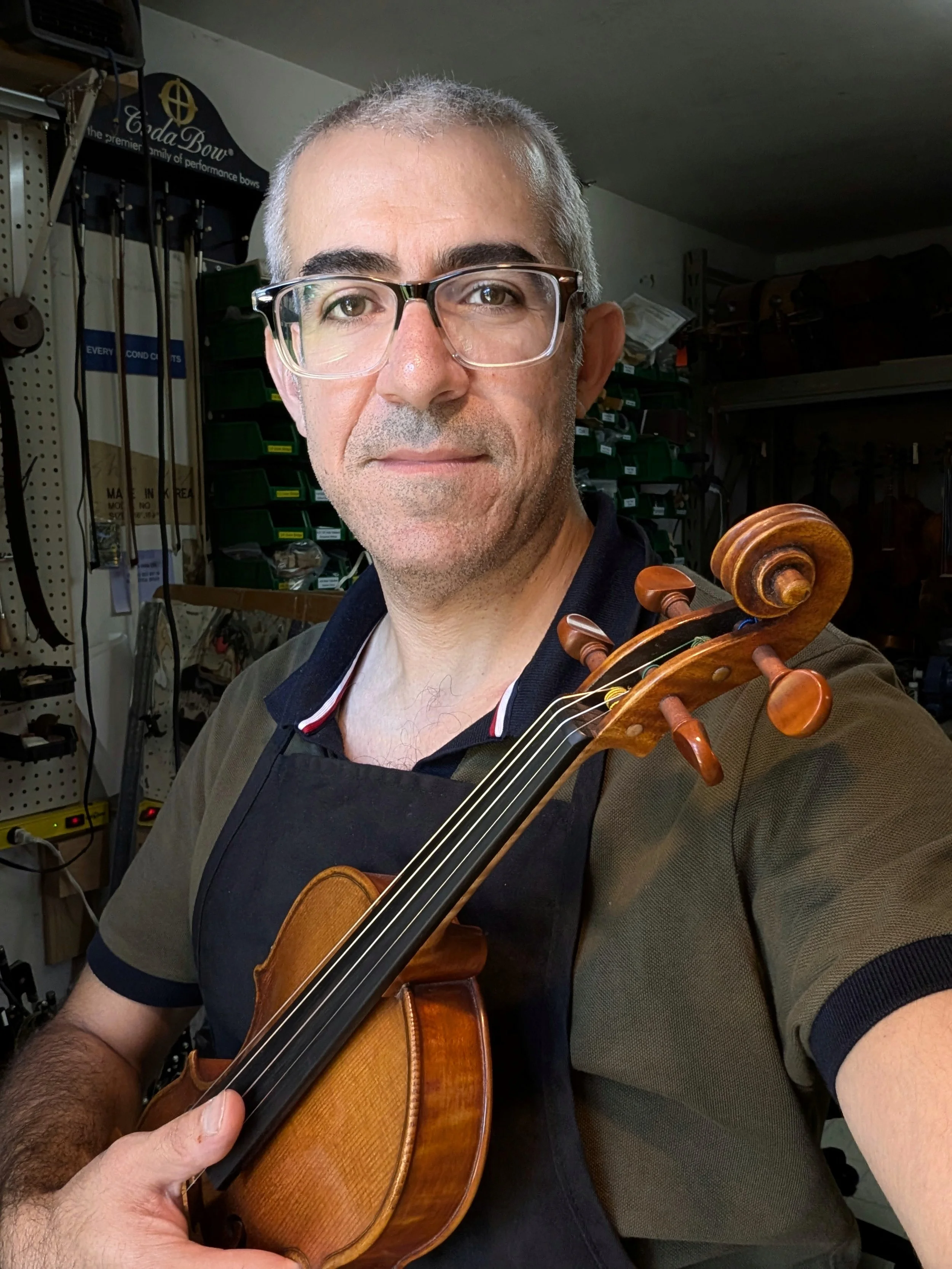
NIKRAY KOWSAR
-

MARIT DANIELSON
-

YOUNG-JU KIM
-

MARCUS BRETTO
-

MELISSA COLLINS
-

CEILE KRONICK
-

TOBY FILLER
-

AARON LEHTONEN
-

CASSIE ROSWOOD