Toby Fuller’s Journey
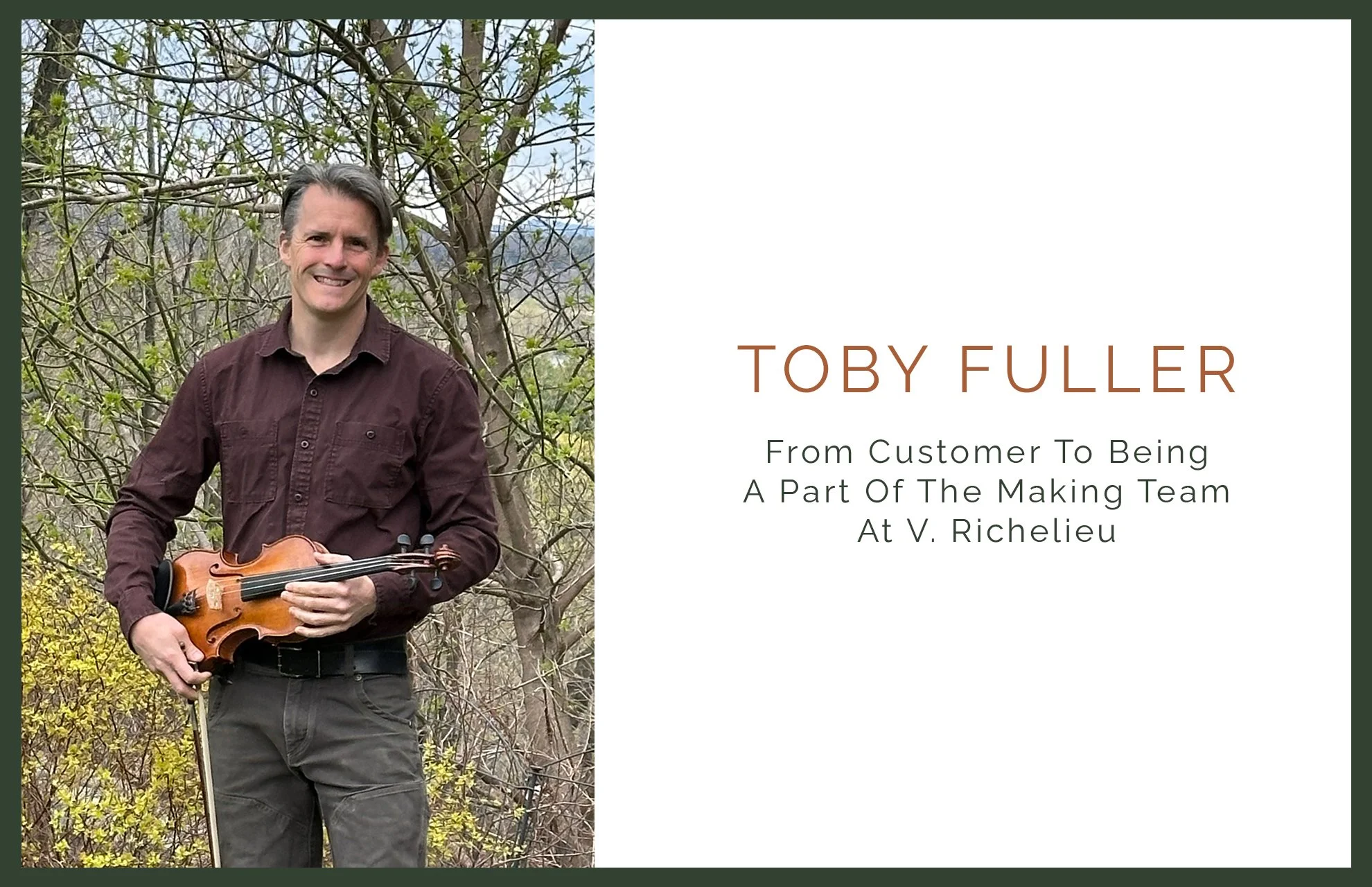
Most people remember the first time they held a violin. For Toby, it wasn’t in a stuffy conservatory or a school music room—it was on a lunch break.
Before he was a master of CAD/CAM and CNC machining at V. Richelieu, Toby worked in architecture. His office happened to be right across the hall from the very first V. Richelieu shop. He would drop in, drawn by the smell of wood and the quiet focus of the luthiers.
"It Was Like Stepping Into a Past World"
Long before Toby ever picked up a bow, he picked up the scent of fresh-cut spruce drifting out of a door that had just appeared across the hall from his architecture office.
"I have had a lifelong fascination with the violin, but I never had the opportunity to try it play growing up. So I took it as a sign when one of the earliest Vermont Violins stores moved into the building I was working in."
Kathy and Oren had just moved the shop into the building — a small, somewhat impractical space, but one that crackled with intention. A display room full of instruments on one side. Jim, the luthier, crammed into the back with a workbench and an ongoing repair on a Stradivarius. He was explaining, with barely contained enthusiasm, to anyone who would listen.
"It was like stepping into a past world," Toby recalls. "The luthiers, focused at their workbenches, would show me repair projects they were laboring over. Hours of meticulous hand work to repair instruments that seemed to be half machine and half sculpture."
He went over, the way anyone would — just to say hello to the new neighbors. Kathy, warm and welcoming as ever, drew him in. And Jim showed him a Strad mid-patch, gesturing at the incision in the instrument's body with something between surgical precision and theatrical delight: Look at this. We're cutting this part out and putting this part in.
Toby was hooked — not yet as a player, but as someone who recognized, instinctively, that something remarkable was happening in that small room.
There is a particular kind of person who doesn't stumble into the world of lutherie by accident. An architectural engineer by training, a ballroom dancer by passion, a sometime dog musher in Alaska — he is also, somewhat inevitably, a V. Richelieu team member who has spent the better part of a decade playing violin and viola with equal devotion on both sides of his body.
Breaking the "Five-Year-Old" Stereotype
Growing up in a sports-oriented household, music had never been Toby's territory. He played tennis. He played more tennis. He briefly taught himself guitar in college and got "fine" at it before life moved on. For years, he held onto the common myth that if you don't start the violin by age five, the window has closed. Then, in his twenties, he lived off the grid in an Alaskan cabin outside Fairbanks — and thought: this would be a good opportunity to learn some violin.
He rented one. He brought it to the cabin. He tuned it.
He broke the e string immediately.
"I didn't have the ear for how tight to go," he laughs. "I played three strings for a couple of weeks. It really wasn't working, and I had some survival issues to contend with" He returned the instrument. The violin would have to wait.
It waited nearly twenty more years — until a trip to New Orleans, wandering the streets, he stumbled upon the violin/guitar street performers, Tanya and Dorise ), and they stopped Toby cold.
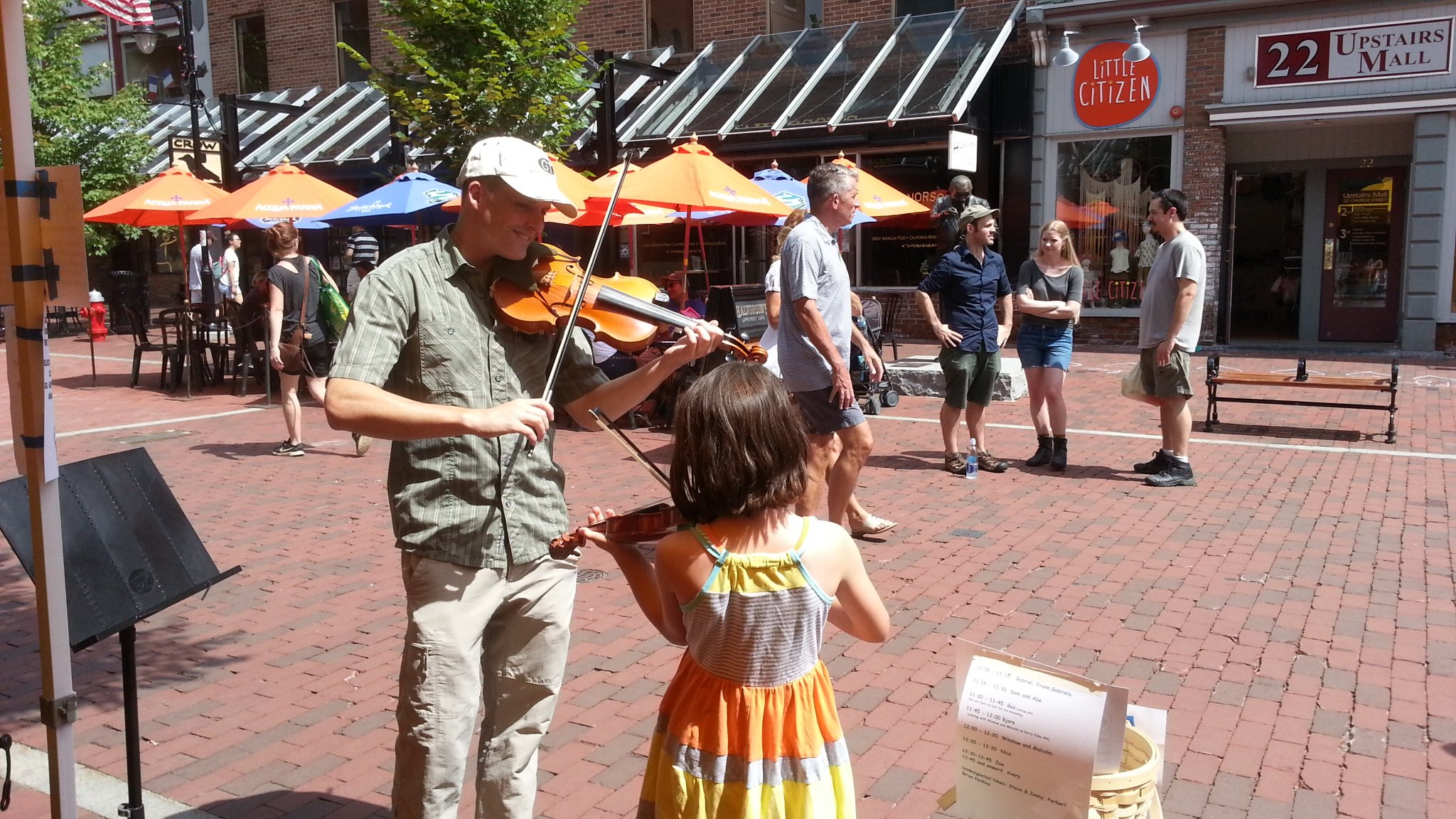
"Maybe because I was just coming off a bar on Bourbon street, but they were so cool and their music was so effortless and fun, that was the time I was like, I don’t care how impractical this is, I absolutely have to try learning this instrument. As soon as I returned to Burlington I pulled up the Vermont Violins website and, rented a violin. I was determined to give it a serious attempt. Part of this journey for me has been a defiance of the violin and broader musical stereotype—that you have to start at five to get fulfillment. I basically started at 42. It’s challenging, it doesn’t always sound great, but it balances something in my being."
The Parent, the Adult Beginner, and the Technical Purist
Among the customer stories that line the V. Richelieu walls — Daniel Longnecker, Coco Brown, Camille Heidel — Toby finds pieces of himself refracted in each one.
In Camille's story, he is the parent. Both of his children have musical stories of their own that began when he brought music into his own life. He knows, intimately, the fine-edged tension of how much do you push before you push them away?
"The payoff is really down the road," he says. "And it's very hard initially. They have a lot of other stuff competing for their interests. How do you get them to the payoff without making them hate it in the process?"
In Daniel's story, he hears his own almost gravitational pull toward music. The attraction that doesn't subside no matter how many decades or broken strings stand in between.
"There's just an attraction to music that, even when I take a break from playing, it's like — no, that's something I really need to do for me. It doesn’t entirely make sense, but it is one of the few things in my life that seems worth continuous devotion."
And in Coco's story, he recognizes the long and very physical education of learning not just how to play, but how to hold the instrument. A decade in, Toby still experiments with arm angle, chin rest position, shoulder rest placement.
"I swear that I am still trying to hold it," he says — not with frustration, but with the kind of wry humor that belongs to someone who understands that mastery is a direction, not a destination.
The Ambidextrous Secret
Here is where Toby's story takes a turn that surprises even his closest colleagues.
He plays both sides.
With a background in physical therapy and kinesiology, Toby grew uncomfortable spending all his practice time in one postural position. So he set up a second violin — mirrored, truly mirrored, with the bass bar and sound post reversed, the strings flipped — to play left-handed. He typically plays viola this way and violin the conventional way, switching between the two to balance his body and keep his brain genuinely challenged.
"The sides of my body play differently," he explains, for example my vibrato works much differently on one side than the other, more wrist on the left, more arm on the right. Sometimes that really helps — oh, that's how this should feel. Let me try doing that more on this side."
He doesn't usually mention this. It tends to prompt extensive follow-up questions.
"I can play ambidextrously, so I play left-handed a lot — I play backwards, where my left hand is the bow hand. And that's partly from my background in physical therapy and kinesiology, where I don't like being in one position all the time. Here you've drawn it out of me, but that’s ok, I don’t think the orchestra police will come after me."
Left-handed violins are notoriously difficult to source. V. Richelieu has never made one. So Toby has acquired several from other makers. Six violins on the wall is not, he clarifies, hoarding — it is a practical consequence of playing a highly unusual way.
The View from Both Sides of the Bench
The idea of joining the V. Richelieu team didn't arrive as a lightning bolt. It arrived, as most of Toby's best ideas do, as a slow accumulation of evidence that something was right.
He first broached the idea with Kathy years ago, when the Burlington shop was still on Church Street — close to his architecture office, close to his daily life. Then 2020 happened, and that particular plan dissolved into the uncertainty everyone shared.
But the idea didn't dissolve. It waited.
"It was still on my mind six years later when I reached out to Oren. Yes, I guess it felt somewhat inevitable that I wanted to be involved in some way."
What drew him in wasn't any single conversation or performance. It was the atmosphere. The way the shop felt like somewhere you made excuses to visit, even when you had no particular errand. The way Kathy always made every entrance feel like a genuine welcome into something alive and meaningful.
So he walked in — this time, not across a hallway, but through a door of his own choosing.
Behind the Curtain: What You Don't See When You Hold a Finished Violin
There is a moment that reframes everything.
For Toby, it happened not long after joining the team, surrounded by piles of discarded components — pieces of spruce and maple that had come within millimeters of becoming part of an instrument before a void, a knot, or a wayward tool caught the grain the wrong way.
"I never imagined how many things have to go right in the making of an instrument for it to be there in your hands as a customer. Not only does each instrument start with wood of extraordinary quality, cut, and conditioning — but the shaping of it is rife with hazard every step of the way."
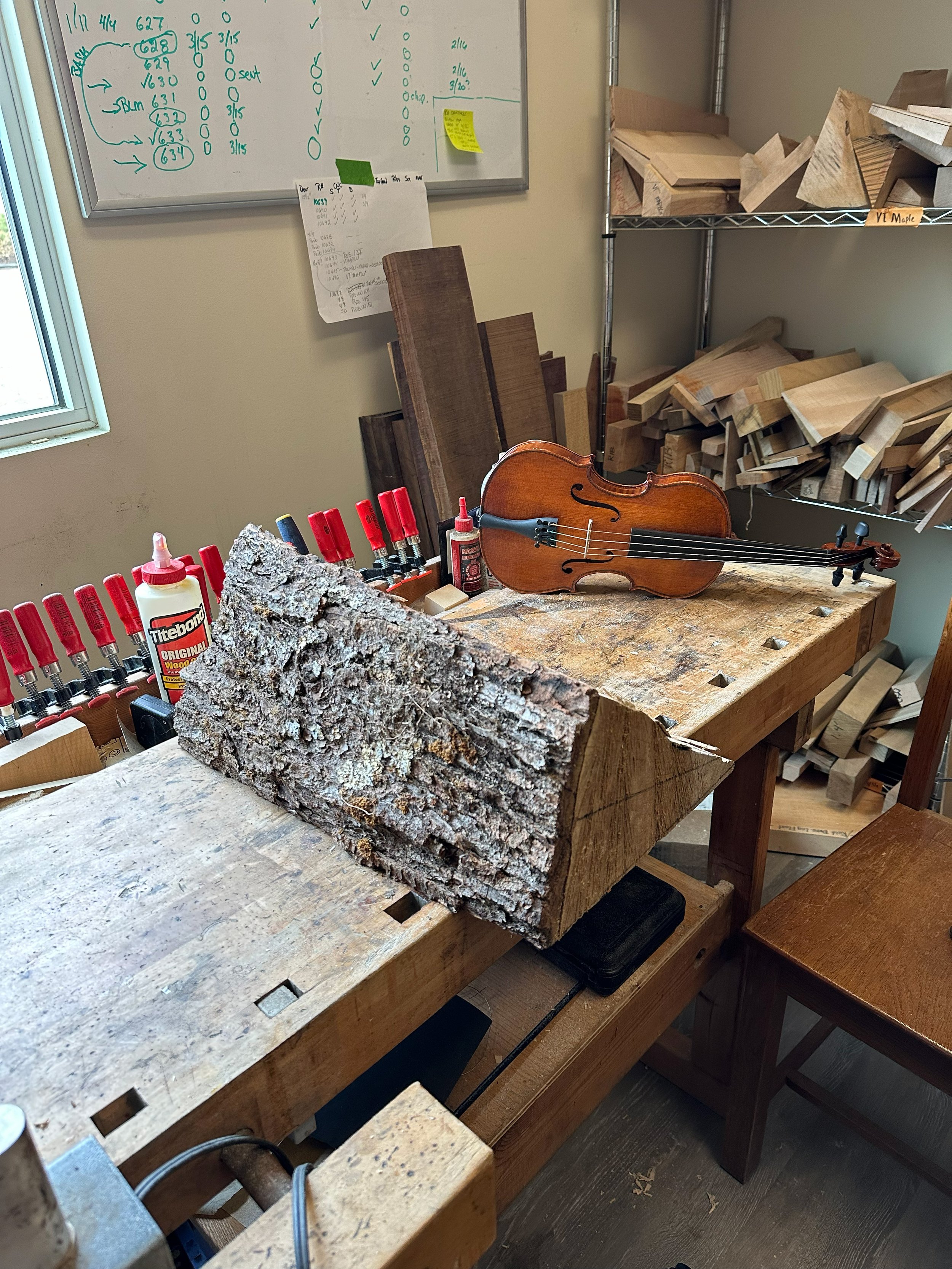
The scrapped pieces are not failures. They are, Toby says, the price of integrity. And they make him hold a finished instrument with a reverence that deepens the longer he works there.
"This could have been three violins," he thinks now, every time a completed instrument passes through his hands. "But we got one."
As for the luthiers themselves — Toby came from twenty years of architecture, a field not exactly known for casual attention to detail. He thought he knew what rigorous looked like.
"Having worked in architecture for twenty years I thought I was pretty detail oriented until I started working with these luthiers. I won't use words for their attention to detail because the only ones that come to mind are pathological — but never underestimate how much they care about a hundredth of a millimeter."
The "Apprentice" with a Robotic Arm
Toby's role at V. Richelieu sits at the intersection of his two worlds: the architectural and engineering precision he has practiced for decades, and the intimate, hand-governed craft of lutherie. He operates the CNC machinery, manages CAD and CAM processes, and applies the same iterative logic he once used on building plans to the gradations of instrument plates.
And yet — he bristles, gently but firmly, at any suggestion that technology diminishes the human heart of the work.
"There isn't a single component that goes from our machining process directly into an instrument. With all of our CAD, CAM, and CNC technology, it only starts a crafting process that relies on continued progression through many skilled human hands."
His favorite analogy is domestic, and deliberately so: "I enjoy cooking, but I don't grind my own flour or buy sugar in a cane stalk." Technology serves craft. It does not replace it.
He goes further. In a traditional master luthier's workshop, the master would never rough out a plate personally — an apprentice would do the heavy initial work, freeing the master's attention for the judgments that truly matter. At V. Richelieu, the CNC machine is that apprentice. A very precise, very reliable, very patient robotic apprentice.
"We're using what you can, because as humans we are limited with our capacity. We're trying to save our energy for its greatest impact — where we can apply it most."
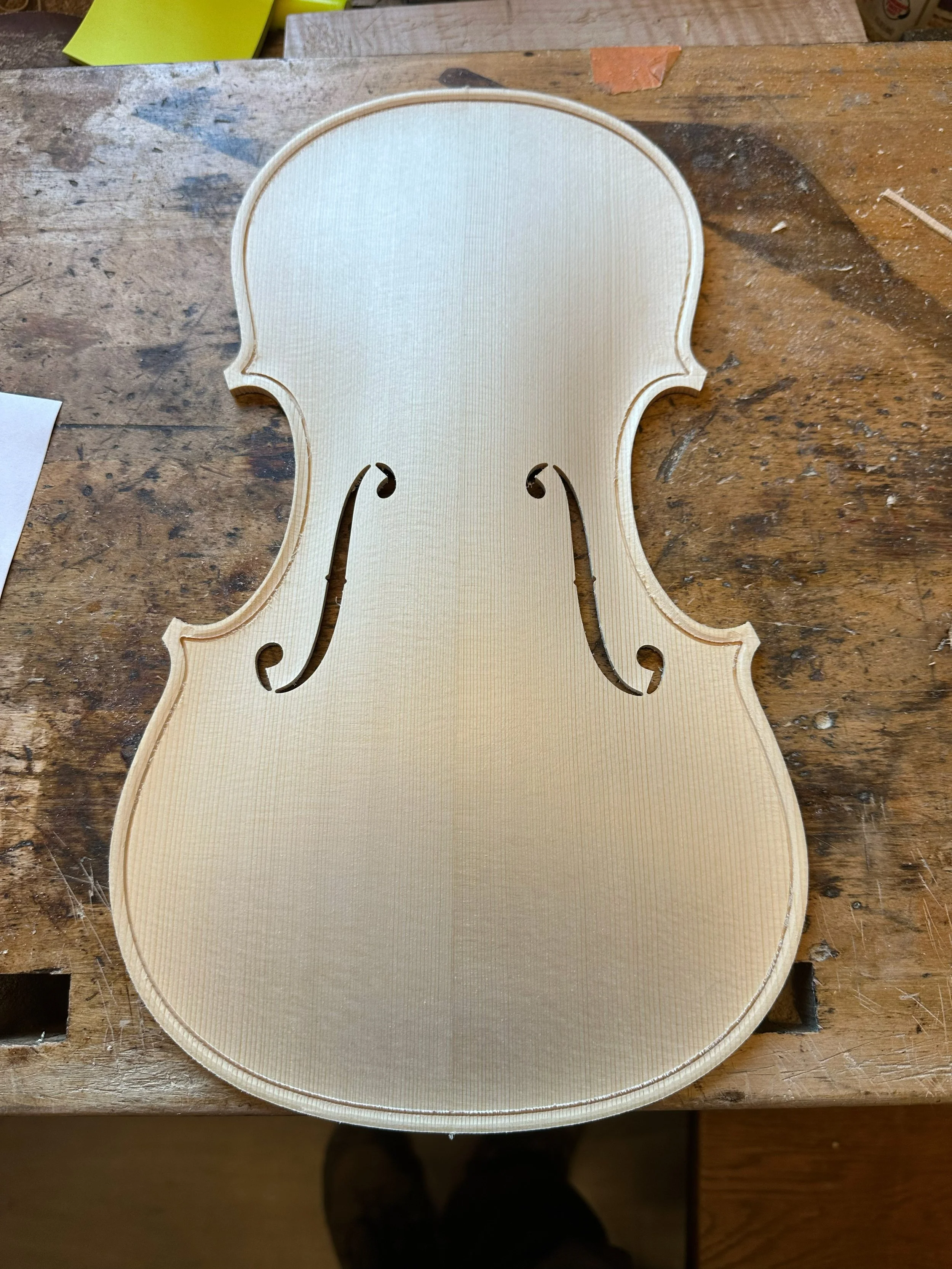
And the iterative nature of the work surprises even the most technically minded observers: of a recent batch of eight plates, five were meaningfully different from one another as the team refined, adjusted, refined again. The machine isn't stamping out identical copies. It is enabling a kind of experimental precision that would be impossibly time-consuming to achieve by hand alone.
“Material science and engineering rarely pause so we are always continuing to monitor and experiment with new materials and methods focusing on performance and sustainability. I’m hoping improvements in technology will also mitigate the aforementioned piles of scrapped parts by catching errors more efficiently. Finally, we are always considering increasing our product line. There are whispers of a V. Richelieu Cello drifting through the shop. Shhh!”
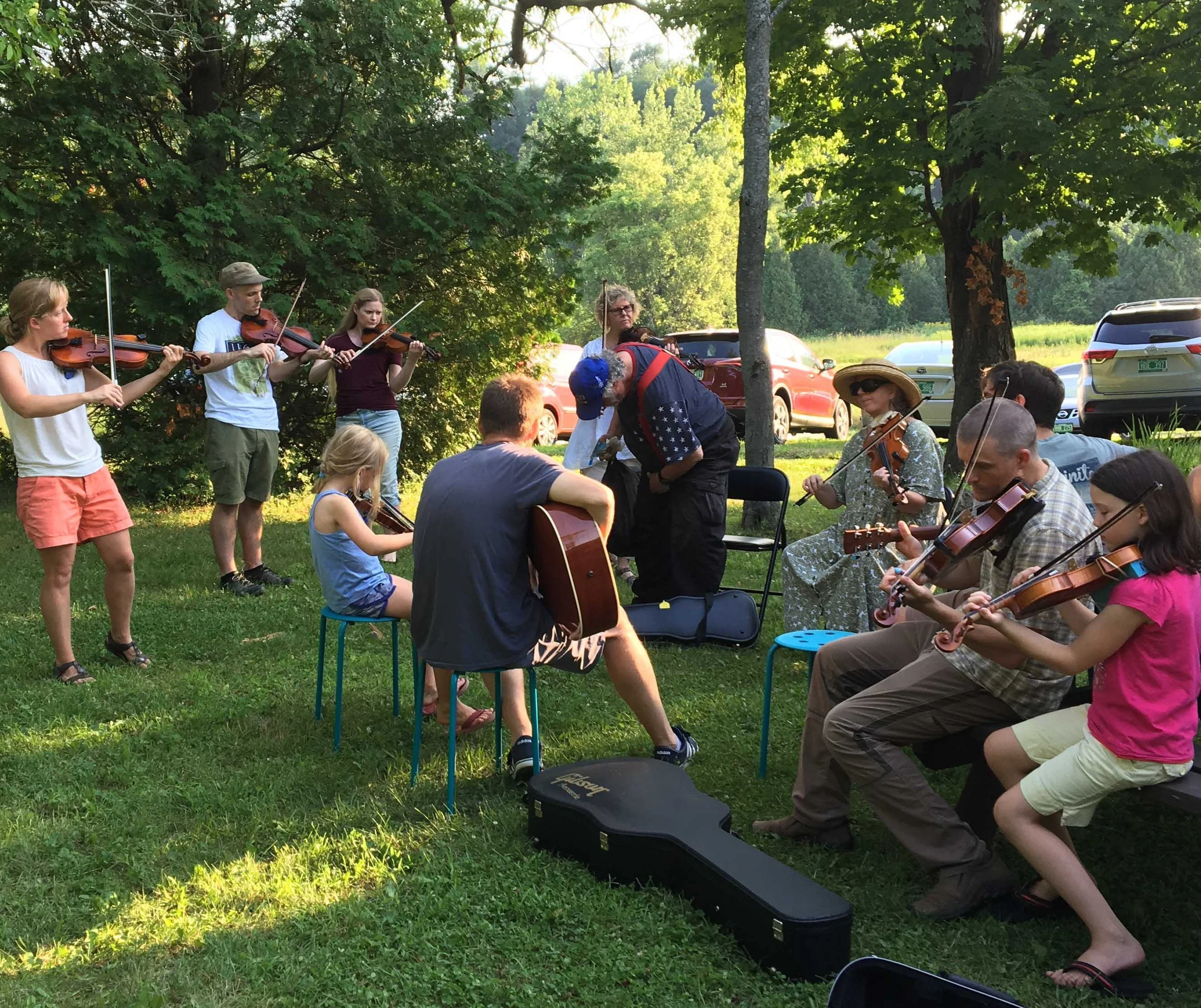
What Music Is Up Against — And Why It Matters
At V. Richelieu, we often talk about the "Seven Generation" rule—the idea that what we make today should still be singing 200 years from now. This sense of legacy is what keeps Toby focused, even when he’s obsessing over a hundredth of a millimeter.
V Richelieu’s commitment to sustainability reminds me of LEED accreditation in architecture. It is not the easiest way to build, it is not the cheapest way to build, but it is the most responsible way to build if you look at your instrument as an investment that is a benefit and not an expense on the future.
"Most buildings I worked on as an architect have a lifespan of 40 or 50 years," Toby says. "It’s incredible to work on something that is expected to age better than I will. It’s an heirloom."
He and his wife dance. Ballroom dancing, proper ballroom dancing, waltz and foxtrot, in a city not particularly designed for it. They seek out the once-a-month events. They find their people.
And he watches the parallel erosion happening in both dance and music: fewer people making, more people consuming, the creeping quiet of a society increasingly content to watch rather than participate.
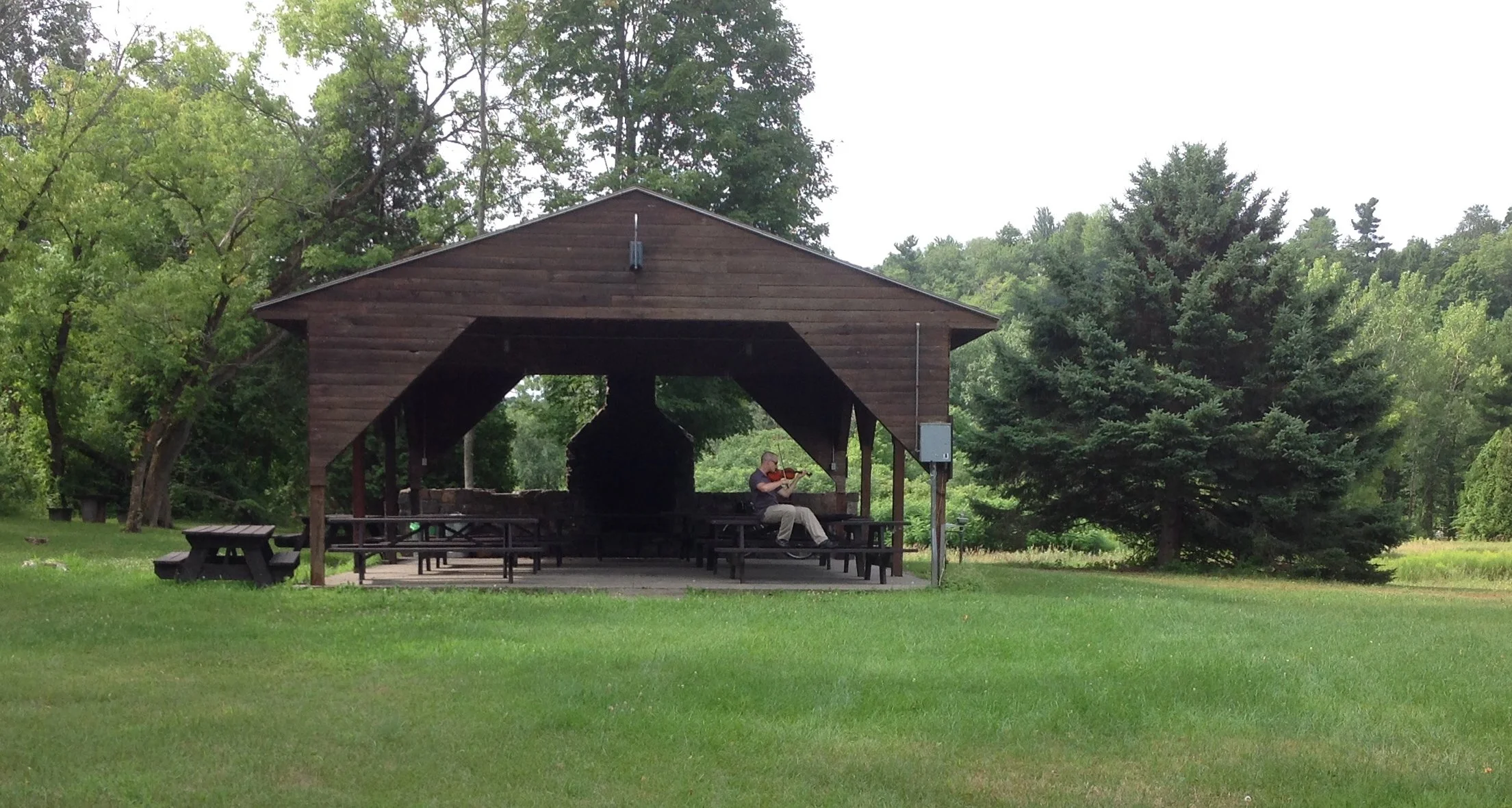
"I really feel like you want to make sure music has an inroad in as many ways as possible into people's lives now. Or I feel like sometimes we're becoming a society that just sits and watches — consumes on our headphones — with very few people actually making things happen anymore."
This is why accessibility isn't a pricing strategy. It is, for Toby, a cultural argument. When V. Richelieu offers rental programs, financing options, and entry points that don't require a significant financial leap of faith, it isn't compromising on quality — it is widening the door so that more people can discover what he discovered: that music does something irreplaceable for the human interior.
"Stringed instruments have such a reputation for being expensive — and not entirely undeserved — and for me that was an initial barrier to even consider playing. I did not realize that rental programs had become really reasonably priced until I looked at the Vermont Violins rates for the first time."
To someone standing on the threshold, uncertain whether they are too old, too busy, too inexperienced, too late — Toby's message is consistent and direct: Come in. It's not a closed thing.
Toby’s Advice for the Hesitant Beginner
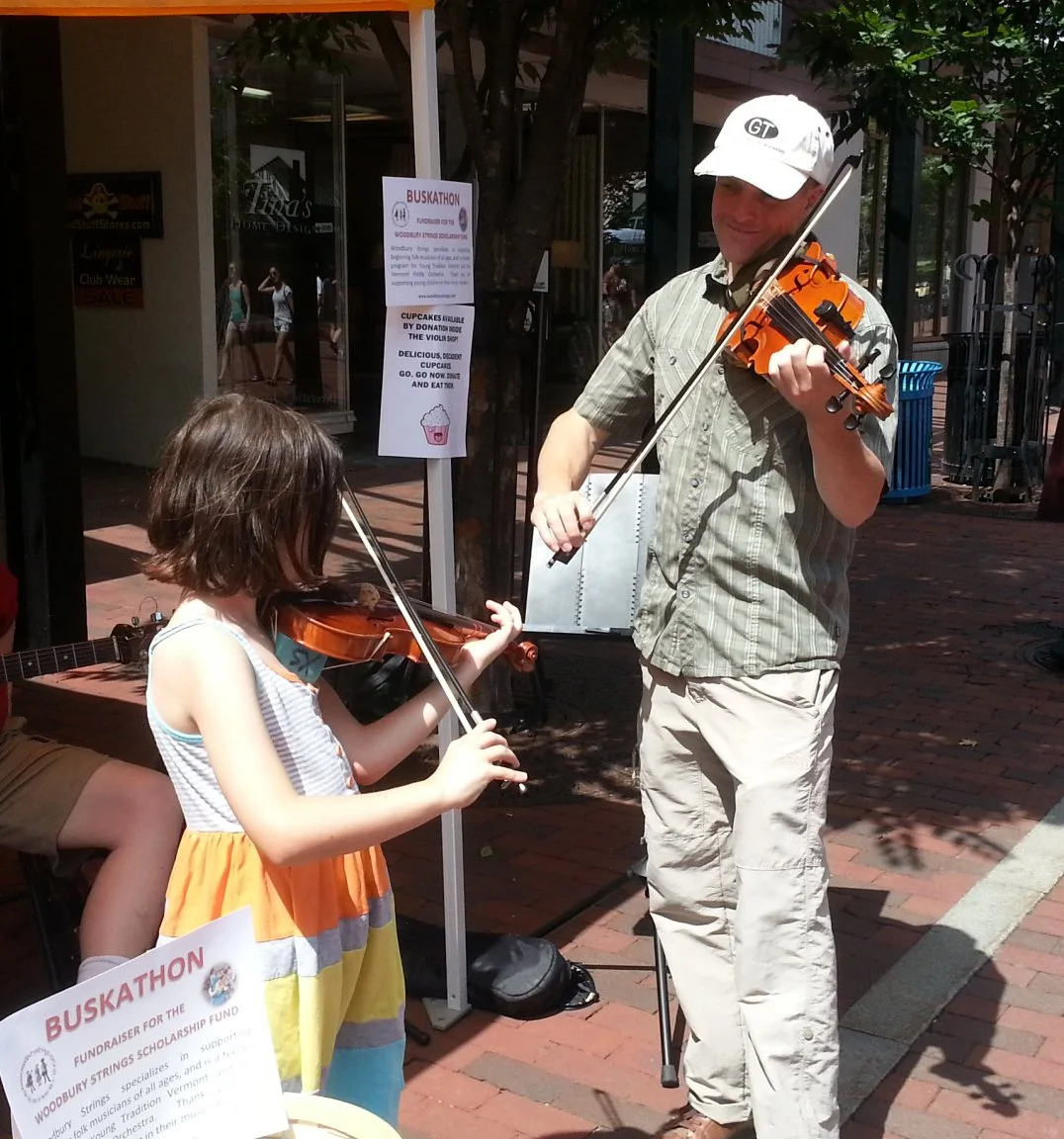
Ten years of playing, a collection of violins on the wall, two different physical setups, a decade of adult-beginner group sessions he used to organize, and now a working knowledge of how the instruments are made — Toby has earned the right to speak plainly about where to begin.
His guidance has a refreshing lack of mysticism.
Start with a rental. Schedule a couple of lessons — for yourself or your kids. See where things lead.
He was nervous to hold a violin for the first time. The idea of coordinating a bow in a second hand while managing the instrument itself felt, frankly, unreasonable. He says so. And then he says what he learned: focus on the basics. Don't let the overwhelming nature of the instrument become a reason to delay.
"I had a whole collection of chin and shoulder rests before I even considered changing my instrument, but at a certain point it became obvious that investing in a higher level instrument would progress my playing. That is when I started trying many different makers' instruments — among them a V. Richelieu that really felt right."
And on the question of starting on a quality instrument: there is something he has observed that the data supports, even if no dataset captures it neatly. A well-made instrument responds to being in tune in a way a lesser one cannot. When you play a note correctly on a V. Richelieu, the whole instrument lights up — it vibrates, it rewards you. A cheaper instrument can leave you doubting whether you are in tune at all, because the feedback loop simply isn't there. For a beginner, that feedback matters enormously.
Finding the Right Instrument
Some customer stories are about finding the right instrument. Some are about proving a point to a skeptical world. Some are about a parent watching a child discover something that will carry them through the rest of their life.
Toby's story is all of these — and something rarer still. It is the story of someone who looked across a hallway in his twenties, recognized something worth understanding more deeply, and spent the next two decades quietly making his way toward it.
He is, at once, the curious neighbor who first walked into the shop, the adult beginner who proved that 42 is not too late, the parent who built a musical environment for his children, and the team member who brings architectural precision to the intimate world of lutherie.
"I've done many things. But the fact that the whole team is invested in doing the best job they can on every instrument — that's really special. It makes the whole thing worth doing."
Are you curious about whether a V. Richelieu might be the right next chapter in your musical story? Explore our rental program, purchase options, or simply reach out — we have always believed the door should be open wide.

V. Richelieu viola are 100% made in Vermont. Hand-split spruce tonewood is imported from Italy and Switzerland; maple comes to us from Bosnia. Together, these woods form a viola of unique distinction offering fine instrument quality at very affordable prices.Our child-sized violas are true violas: modeled after a 16” model, scaled down for children. Finally, a fractional viola that actually sounds like a viola! Most small violas are modeled after violins, and the resulting instruments never perform…our V. Richelieu violas sing with the resonance a viola is meant to have: from the soaring highs of the A string to the haunting lows of the C.Each instrument is hand-graduated by our senior luthiers. The oil-based varnish is hand painted by an accomplished oil portrait artist. Each instrument is unique, but each offers a tonal quality perfect for the advancing student, conservatory student or professional player.
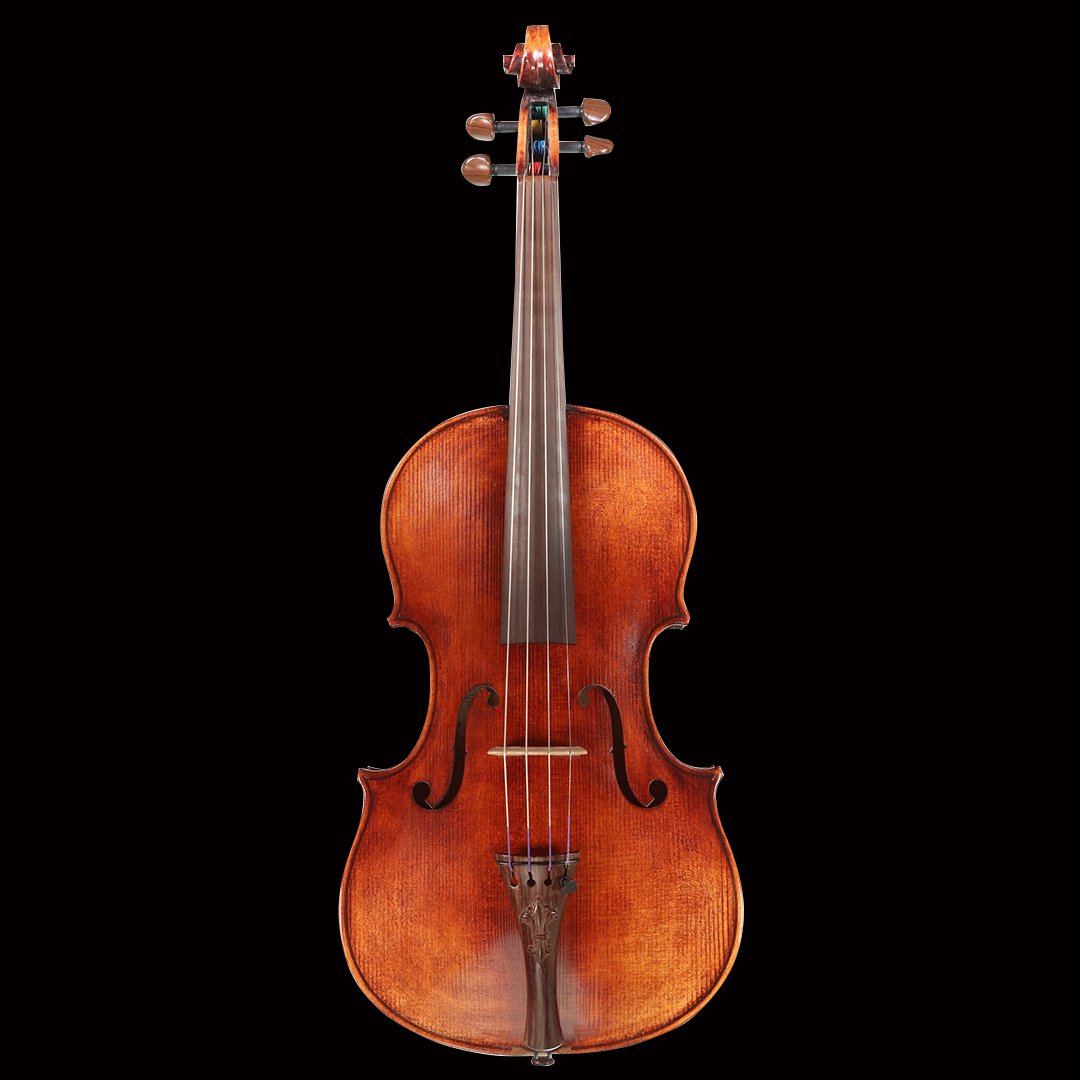
V. Richelieu viola are 100% made in Vermont. Hand-split spruce tonewood is imported from Italy and Switzerland; maple comes to us from Bosnia. Together, these woods form a viola of unique distinction offering fine instrument quality at very affordable prices.Our child-sized violas are true violas: modeled after a 16” model, scaled down for children. Finally, a fractional viola that actually sounds like a viola! Most small violas are modeled after violins, and the resulting instruments never perform…our V. Richelieu violas sing with the resonance a viola is meant to have: from the soaring highs of the A string to the haunting lows of the C.Each instrument is hand-graduated by our senior luthiers. The oil-based varnish is hand painted by an accomplished oil portrait artist. Each instrument is unique, but each offers a tonal quality perfect for the advancing student, conservatory student or professional player.
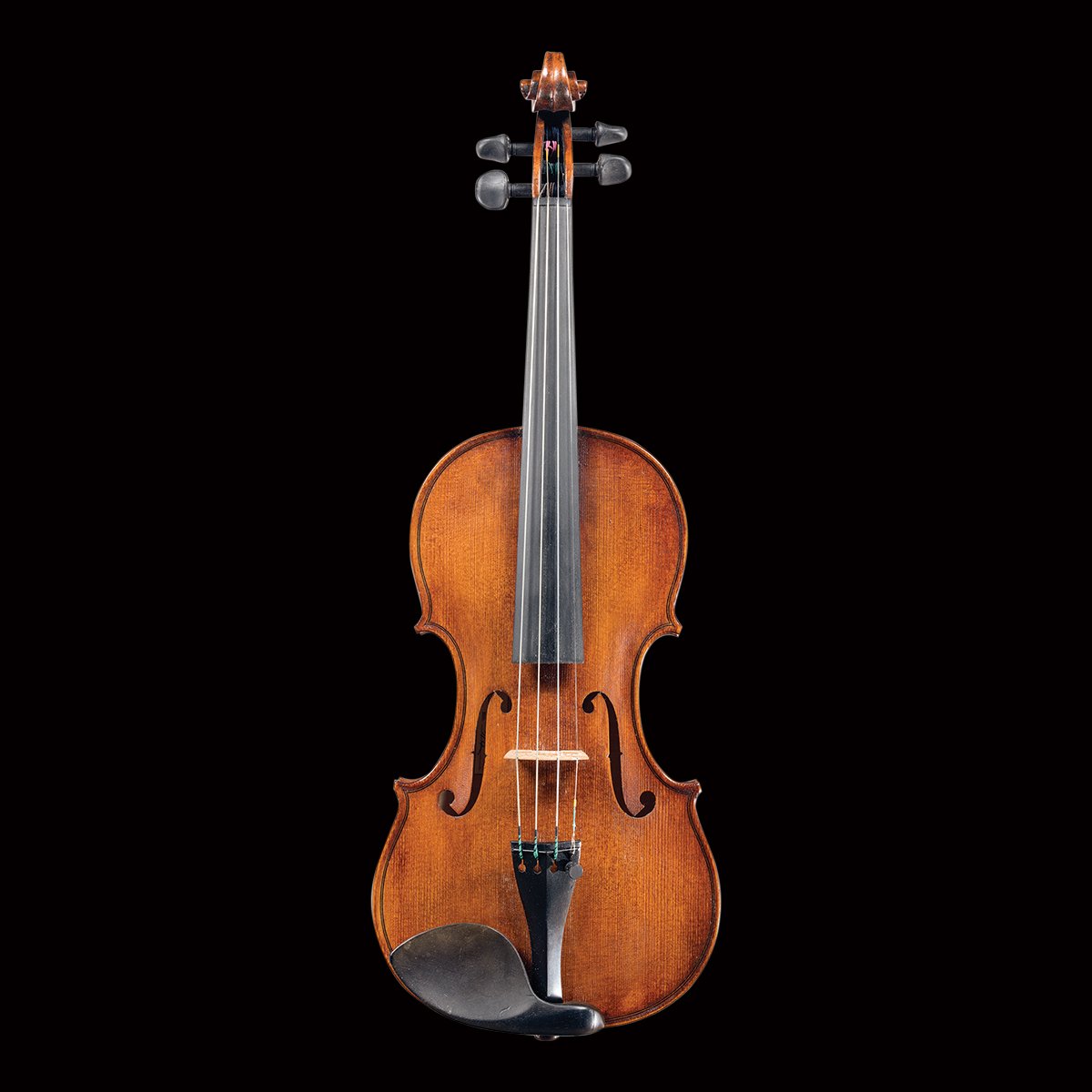
V. Richelieu violins are 100% made in Vermont. Hand-split spruce tonewood is imported from Italy and Switzerland; maple comes to us from Bosnia. Together, these woods form a violin of unique distinction offering fine instrument quality at very affordable prices.Each instrument is hand-graduated by our senior luthiers. The oil-based varnish is hand painted by an accomplished oil portrait artist. Each instrument is unique, but each offers a tonal quality perfect for the advancing student, conservatory student or professional player.